 Real math help.
Equations and Inequalities
More Specific Topics in Equations and Inequalities
Popular Tutorials in Equations and Inequalities
-
What are the Multiplication Properties of 0 and -1?
Understanding the multiplication properties of 0 and -1 are fundamental building blocks in learning all there is to know about the operation of multiplication. In this tutorial, you'll learn about these two important properties.
-
What are the Inverse Properties of Addition and Multiplication?
Inverse properties of addition and multiplication got you stumped? This tutorial should help! Check it out and learn these two important inverse properties.
-
How Do You Find the Absolute Value of Positive and Negative Numbers?
Finding the absolute value of a number is a breeze when you use a number line! Remember, absolute value is the distance from zero on the number line. This tutorial shows you how to use a number line to find absolute value.
-
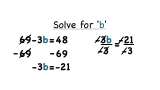
How Do You Solve a Two-Step Equation by Multiplying by -1?
Got a negative variable in an equation? Want to get rid of that negative sign? This tutorial shows you how by using the multiplication property of -1!
-
How Do You Solve a Two-Step Equation by Combining Like Terms?
Trying to solve an equation where you see the same variable more than once? Figure out how to get those variables together and solve the equation with this tutorial!
-
How Do You Solve for a Variable in a Fraction Using Multiplication First?
Trying to solve an equation involving a fraction? Just multiply the fraction away and then perform the order of operations in reverse! See how in this tutorial.
-
How Do You Solve a Two-Step Equation by Multiplying by a Reciprocal?
Trying to solve an equation involving a fraction? Just multiply the fraction away by multiplying by the reciprocal and then perform the order of operations in reverse! See how in this tutorial.
-
How Do You Solve an Identity Equation?
Trying to solve an equation with variables on both sides of the equation? Figure out how to get those variables together and solve the equation with this tutorial!
-
How Do You Solve an Equation with No Solution?
Trying to solve an equation with variables on both sides of the equation? Figure out how to get those variables together and solve the equation with this tutorial! Surprise! Turns out, this equation has no solution. Check out this tutorial and see why!
-
How Do You Solve an Equation with Variables on Both Sides and Grouping Symbols?
Trying to solve an equation with variables on both sides of the equal sign and grouping symbols? Watch this tutorial to figure out how remove the grouping symbols and get those variables together to solve the equation.
-
How Do You Solve a Two-Step Equation by Multiplying by -1 First?
Got a negative variable in an equation? Want to get rid of that negative sign? This tutorial shows you how by using the multiplication property of -1!
-
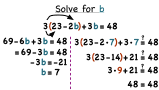
How Do You Solve a Two-Step Equation by Distributing a Fraction First?
Trying to solve an equation for a variable? Are grouping symbols in the way? Watch this tutorial to figure out how remove the grouping symbols and solve the equation!
-
What is an Identity Equation?
Identity equations are equations that are true no matter what value is plugged in for the variable. If you simplify an identity equation, you'll ALWAYS get a true statement. Learn about identity equations in this tutorial, and then create your own identity equation. Get creative! The possibilities are endless!
-
What Does It Mean When An Equation Has No Solution?
Sometimes equations have no solution. This means that no matter what value is plugged in for the variable, you will ALWAYS get a contradiction. Watch this tutorial and learn what it takes for an equation to have no solution.
-
How Do You Solve a Formula For a Variable?
So you're working on a math problem and you have the correct formula. Great! But the variable you need to solve for is not by itself in the formula. Not so great. Don't worry! In this tutorial, you'll learn how to solve a formula for the variable you want!
-
How Do You Solve an OR Compound Inequality and Graph It On a Number Line?
Trying to solve a compound inequality? No problem! This tutorial will take you through the process of splitting the compound inequality into two inequalities. Then you'll see how to solve those inequalities, write the answer in set builder notation, and graph the solution on a number line.
-
How Do You Solve a Word Problem Using an AND Compound Inequality?
Word problems allow you to see math in action! This tutorial deals with turning a word problem into a compound inequality and solving that compound inequality to get the answer. Learn how in this tutorial!
-
What is an Identity Inequality?
And identity inequality is an inequality that it true no matter what values we plug in for the variable. Watch this tutorial and learn all about identity inequalities. Then see if you can make your own identity inequality complete with variables!
-
What Does It Mean When an Inequality is a Contradiction or Has No Solution?
Can an inequality have no solution? You bet it can! An inequality has no solution will always give you a contradiction, no matter what value you plug in for the variable. Watch this tutorial, and then try to make your own inequality with no solution!
-
What are Multiplicative Inverses?
Multiplicative inverses. That's a mouthful! Really, this term just refers to numbers that when multiplied together equal 1. These numbers are also called reciprocals of each other! Learn about multiplicative inverses by watching this tutorial.
-
How Do You Solve a Word Problem by Writing an Equation and Plugging in Values?
Setting up and solving an equation from a word problem can be tricky, but this tutorial can help. See all the steps, from defining variables to getting that final answer, and everything in between! With this tutorial, you'll learn what it takes to solve a word problem.
-
What are the Commutative Properties of Addition and Multiplication?
The commutative property is a fundamental building block of math, but it only works for addition and multiplication. This tutorial defines the commutative property and provides examples of how to use it.
-
What are the Identity Properties of Addition and Multiplication?
Let's identify an identity! Addition and subtraction have a different identity than multiplication and division. Learn about each of these identities with this tutorial!
-
How Do You Translate a Phrase with One Variable and Number Into a Mathematical Expression?
Need some practice translating phrases into mathematical expressions? Then this tutorial is for you! You'll get practice translating statements involving addition, subtraction, multiplication, or division into mathematical expressions.
-
What are Natural and Whole Numbers?
The natural numbers are also called the counting numbers. The whole numbers are almost exactly as the natural numbers the same except for one small difference! Watch this tutorial and learn the difference between natural and whole numbers.
-
How Do Different Categories of Numbers Compare To Each Other?
There are a bunch of different categories of numbers such as the rational numbers, the natural numbers, and the integers, just to name a few. See how they all relate to one another by watching this tutorial!
-
How Do You Write an Equation from a Word Problem?
Having difficulty turning a word problem into an algebra equation? Then this tutorial is for you! With this tutorial, you'll learn how to break down word problems and translate them into mathematical equations.
-
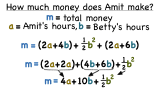
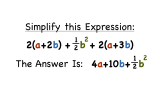
How Do You Simplify an Expression?
Simplifying an algebraic expression is a fundamental part of solving math problems. Get some practice putting an expression in simplest form by following along with this tutorial.
-
How Do You Use the Distributive Property to Simplify an Expression?
In this tutorial you'll see how to apply the distributive property. Remember that this is important when you are trying to simplify an expression and get rid of parentheses!
-
How Do You Use the Associative Property?
Learning the associative property of addition is one thing, but being able to use it can be a completely different challenge. In this tutorial, you'll see how to put this very useful property into action.
-
How Do You Evaluate an Algebraic Expression?
Plugging variables into an expression is essential for solving many algebra problems. See how to plug in variable values by watching this tutorial.
-
How Do You Use the Order of Operations?
If you're trying to simplify some math expressions, you have to do it in the right order. If you've ever wondered how to do that, check out this example tutorial where you'll see exactly what order you need to follow:)
-
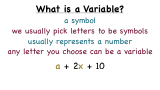
What is a Variable?
You can't do algebra without working with variables, but variables can be confusing. If you've ever wondered what variables are, then this tutorial is for you!
-
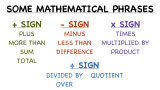
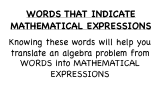
What Are Some Words You Can Use To Write Word Problems?
Knowing the mathematical meaning of words allows you to decipher word problems and gives you the power to write your own word problems, too! Take a look at these words and learn their mathematical translations.
-
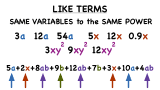
What are Like Terms?
Combining like terms together is a key part of simplifying mathematical expressions, so check out this tutorial to see how you can easily pick out like terms from an expression
-
What is Simplest Form?
Sometimes what's simple for some is hard for others, and so simple seems like a pretty subjective word. But when it comes to algebra, the simplest form of an expressions is very well defined and is very specific- there's really nothing that subjective about it. So watch this tutorial and see exactly what simplest form means!
-
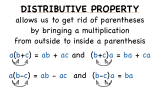
What is the Distributive Property?
The distributive property is a very deep math principle that helps make math work. It's the rule that lets you expand parentheses, and so it's really critical to understand if you want to get good at simplifying expressions. So check out the tutorial and let us know what you think!
-
What are the Associative Properties of Addition and Multiplication?
The associative property is one of those fundamental properties of math that make math work. You probably take this property for granted because it's so ingrained, but it's important to see how the guts of math work, so check out the tutorial and make sure you're solid on your fundamentals!
-
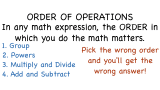
What's the Order of Operations?
Check out this tutorial where you'll see exactly what order you need to follow when you simplify expressions. You'll also see what happens when you don't follow these rules, and you'll find out why order of operations is so important!
-
What's a Coefficient?
There is a bunch of vocabulary that you just need to know when it comes to algebra, and coefficient is one of the key words that you have to feel 100% comfortable with. Check out the tutorial and let us know if you want to learn more about coefficients!
-
How Do You Turn a Longer Verbal Phrase into an Algebraic Expression?
Looking for some practice translating words into a mathematical expression? Then take a look at this tutorial, and you'll learn how to break down those words and write the mathematical expression they describe!
-
How Do You Turn a More Complicated Equation into Words?
Let your creativity go wild by turning a mathematical equation into a story! Watch this tutorial to see one example, and then write your own story to describe the given equation. See how creative you can get with math!
-
How Do You Turn a More Complicated Expression into Words?
This tutorial shows you how a mathematical expression can be turned into words. The best part? You can be super creative with the statement you make up! Check out the example statement created in this tutorial, and then make up your own!
-
What's an Irrational Number?
Is an irrational number just a way to describe a number that's lost its mind? Not really. :) An irrational number is simply a number that cannot be written as a fraction. Check out the definition, learn an important property of these special numbers, and take a look at some examples of irrational numbers.
-
What's a Real Number?
Real numbers are numbers that can be found on the number line. This includes both the rational and irrational numbers. This tutorial explains real numbers and gives some great examples. Take a look!
-
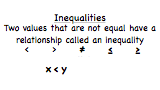
What's an Inequality?
Inequalities come up all the time when you're working algebra problems. In this tutorial you'll learn what an inequality is, and you'll see all the common inequality symbols that you're likely to see :)
-
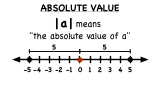
What Does Absolute Value Mean?
In this tutorial you'll see how you can think of absolute value in a very intuitive way. Let us know if you have any questions about it!
-
How Do You Graph a Set on a Number Line?
Number lines are great ways to represent a group of numbers, and in this tutorial you'll see how to graph a group of numbers on a number line
-
What's a Rational Number?
There are lots of different kind of numbers that you should know about, and that includes rational numbers. Check out the tutorial!
-
What's an Integer?
There are lots of different kinds of numbers that you'll come across in algebra, and a lot of these kinds of numbers are related to each other. Before you learn how they are related, you've got to learn about them separately, and in this tutorial you'll how to define integers :)
-
What's a Reciprocal?
Reciprocals are important when it comes to dividing fractions, finding perpendicular lines, dealing with inverse proportions, and so much more! In this tutorial you can review the basics about reciprocals.
-
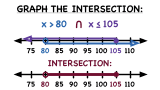
How Do You Graph the Intersection of Two Inequalities?
Number lines help make graphing the intersection of two inequalities a breeze! This tutorial shows you how to graph two inequalities on the same number line and then find the intersection. Take a look!
-
How Do You Graph the Union of Two Inequalities?
Number lines help make graphing the union of two inequalities a breeze! This tutorial shows you how to graph two inequalities on the same number line and then find the union. Check it out!
-
How Do You Distribute With Whole Numbers and Fractions?
This tutorial shows you how to distribute a whole number into the sum of fractions. It's an important skill to have when you're solving equations, and you never know when it can come up. Be sure to check out this tutorial!
-
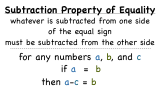
What's the Subtraction Property of Equality?
Solving equations can be tough, especially if you've forgotten or have trouble understanding the tools at your disposal. One of those tools is the subtraction property of equality, and it lets you subtract the same number from both sides of an equation. Watch the video to see it in action!
-
What's the Addition Property of Equality?
Solving equations can be tough, especially if you've forgotten or have trouble understanding the tools at your disposal. One of those tools is the addition property of equality, and it lets you add the same number to both sides of an equation. Watch the video to see it in action!
-
What's the Multiplication Property of Equality?
Solving equations can be tough, especially if you've forgotten or have trouble understanding the tools at your disposal. One of those tools is the multiplication property of equality, and it lets you multiply both sides of an equation by the same number. Watch the video to see it in action!
-
How Do You Solve an Equation with Variables on Both Sides and Fractions?
Trying to solve an equation with variables and fractions on both sides of the equation? You can bet it involves finding a common denominator! To see what it takes, watch this tutorial.
-
How Do You Solve an Equation with Variables on Both Sides?
Trying to solve an equation with variables on both sides of the equal sign? Figure out how to get those variables together and find the answer with this tutorial!
-
How Do You Solve for a Variable in Terms of Another Variable?
Got an equation with two variables? Want to solve for one variable in terms of the other? Want to go the other way around? See how in this tutorial!
-
How Do You Solve a Word Problem Using a Multi-Step Equation?
Working with word problems AND fractions? This tutorial shows you how to take a word problem and translate it into a mathematical equation involving fractions. Then, you'll see how to solve and check your answer. Take a look!
-
How Do You Solve a Multi-Step Equation Using Order of Operations in Reverse?
Trying to solve an equation with variables and fractions? Just perform the order of operations in reverse! To see what it takes, watch this tutorial.
-
How Do You Solve a Word Problem Using a Two-Step Equation with Decimals?
Word problems are a great way to see math in the real world. In this tutorial, you'll see how to translate a word problem into a mathematical equation. Then you'll see how to solve that equation and check your answer!
-
How Do You Solve a Multi-Step Equation with Fractions by Multiplying Away the Fraction?
Trying to solve an equation involving a fraction? Just multiply the fraction away and then perform the order of operations in reverse! See how in this tutorial.
-
How Do You Solve a Multi-Step Equation with Fractions Using Reverse Order of Operations and Reciprocals?
Trying to solve an equation involving a fraction? Just perform the order of operations in reverse! See how in this tutorial.
-
How Do You Solve a Two-Step Equation?
Solving an equation for a variable? Perform the order of operations in reverse! Check it out in this tutorial.
-
How Do You Solve a Multi-Step Equation Using the Distributive Property?
Trying to solve an equation where you see the same variable more than once? Figure out how to get those variables together and solve the equation with this tutorial!
-
What's the Division Property of Equality?
Solving equations can be tough, especially if you've forgotten or have trouble understanding the tools at your disposal. One of those tools is the division property of equality, and it lets you divide both sides of an equation by the same number. Watch the video to see it in action!
-
How Do You Solve a Word Problem Using an AND Absolute Value Inequality?
Word problems allow you to see math in action! This tutorial shows you how to translate a word problem to an absolute value inequality. Then see how to solve for the answer, write it in set builder notation, and graph it on a number line. Learn all about it in this tutorial!
-
How Do You Write an Absolute Value Inequality from a Word Problem?
Sometimes the hardest part of a word problem is figuring out how to turn the words into math. This tutorial let's you see the steps to take in order to do just that! You'll see how to take a word problem and dissect it to turn it into an absolute value inequality.
-
How Do You Solve a Word Problem Using a Multi-Step Inequality?
This tutorial provides a great real world application of math. See how to turn a word problem into an inequality. Then solve the inequality by performing the order of operations in reverse. Don't forget that if you multiply or divide by a negative number, you MUST flip the sign of the inequality! That's one of the big differences between solving equalities and solving inequalities.
-
How Do You Solve a Multi-Step Inequality Using Reverse Order of Operations?
Solving an inequality for a variable? Just perform the order of operations in reverse! Don't forget that if you multiply or divide by a negative number, you MUST flip the sign of the inequality! That's one of the big differences between solving equalities and solving inequalities.
-
How Do You Solve a Word Problem Using an Inequality With Variables on Both Sides?
This tutorial provides a great real world application of math. See how to turn a word problem into an inequality. Then solve the inequality by performing the order of operations in reverse. Don't forget that if you multiply or divide by a negative number, you MUST flip the sign of the inequality! That's one of the big differences between solving equalities and solving inequalities.
-
How Do You Solve an Inequality With Variables on Both Sides?
Solving an inequality for a variable? Just perform the order of operations in reverse! Don't forget that if you multiply or divide by a negative number, you MUST flip the sign of the inequality! That's one of the big differences between solving equalities and solving inequalities.
-
How Do You Solve an AND Compound Inequality?
Trying to solve a compound inequality? No problem! This tutorial will take you through the process of splitting the compound inequality into two inequalities. Then you'll see how to solve those inequalities and write the answer in set builder notation.
-
How Do You Solve an AND Absolute Value Inequality and Graph It On a Number Line?
Trying to solve an absolute value inequality? No sweat! This tutorial will take you through the process of solving the inequality. Then you'll see how to write the answer in set builder notation and graph it on a number line. You'll see it all in this tutorial!
-
How Do You Convert an AND Absolute Value Inequality to a Compound Inequality?
Converting an absolute value inequality to a compound inequality can be tricky. Luckily, this tutorial takes you through the process step-by-step. Take a look! You'll be glad you did.
-
How Do You Solve an AND Compound Inequality and Graph It On a Number Line?
Trying to solve a compound inequality? No sweat! This tutorial will take you through the process of solving the inequality. Then you'll see how to write the answer in set builder notation and graph it on a number line. You'll see it all in this tutorial!
-
How Do You Solve and Graph a Two-Step Inequality?
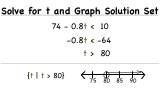
Solving an inequality for a variable? Just perform the order of operations in reverse! Don't forget that if you multiply or divide by a negative number, you MUST flip the sign of the inequality! That's one of the big differences between solving equalities and solving inequalities.
-
How Do You Write Inequalities in Set Builder Notation?
Need some extra practice converting solution phrases into set builder notation? This tutorial was made for you! Follow along as this tutorial shows you how to dissect each phrase and turn it into a solution in set builder notation.
-
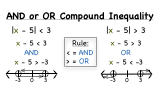
How Do You Figure Out if an Absolute Value Inequality is an AND or OR Compound Inequality?
When does an absolute value inequality represent an AND compound inequality? When does it represent an OR compound inequality? This tutorial will give you the answer and show you using examples on a number line!
-
What's a Compound Inequality?
Wondering what a compound inequality is? Then check out this tutorial! You'll learn the definition for a compound inequality and also see how it can be written in set builder notation. Take a look!
-
What's the Subtraction Property of Inequality?
Ever wondered what rules you're allowed to follow when you're working with inequalities? Well, one of those rules is called the subtraction property of inequality, and it basically says that if you minus a number from one side of an inequality, you have to minus that same number from the other side of the inequality as well. Watch the tutorial to see how this looks in terms of algebra!
-
What's the Addition Property of Inequality?
Ever wondered what rules you're allowed to follow when you're working with inequalities? Well, one of those rules is called the addition property of inequality, and it basically says that if you add a number from one side of an inequality, you have to add that same number from the other side of the inequality as well. Watch the tutorial to see how this looks in terms of algebra!
-
What's the Division Property of Inequality?
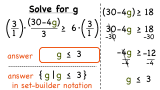
Ever wondered what rules you're allowed to follow when you're working with inequalities? Well, one of those rules is called the division property of inequality, and it basically says that if you divide one side of an inequality by a number, you can divide the other side of the inequality by the same number. However, you have to be very careful about the direction of the inequality! Watch the tutorial to see how this looks in terms of algebra!
-
What's the Multiplication Property of Inequality?
Ever wondered what rules you're allowed to follow when you're working with inequalities? Well, one of those rules is called the multiplication property of inequality, and it basically says that if you multiply one side of an inequality by a number, you can multiply the other side of the inequality by the same number. However, you have to be very careful about the direction of the inequality! Watch the tutorial to see how this looks in terms of algebra!
-
What is a Constant?
Constants are parts of algebraic expressions that don't change. Check out this tutorial to see exactly what a constant looks like and why it doesn't change.
-
What's Another Definition for an Integer?
Integers are everywhere in math, so it's important to know what an integer is. This tutorial explains this special type of number so that you can identify one when you see it! Sometimes, a number is an integer even though it doesn't look like one. Watch this tutorial to see how to identify those too!
-
What's a Term?
Polynomials are those expressions that have variables raised to all sorts of powers and multiplied by all types of numbers. When you work with polynomials you need to know a bit of vocabulary, and one of the words you need to feel comfortable with is 'term'. So check out this tutorial, where you'll learn exactly what a 'term' in a polynomial is all about.
-
What are Equivalent Expressions?
If two things are equivalent, they are the same. Equivalent expressions are expressions that are the same, even though they may look a little different. If you plug in the same variable value into equivalent expressions, they will each give you the same value when you simplify. Learn more about equivalent expression by watching this tutorial!
-
What Are Numerical and Algebraic Expressions?
An expression is just a mathematical phrase. In this tutorial, you'll learn about two popular types of expressions: numerical and algebraic expressions. A numerical expression contains numbers and operations. An algebraic expression is almost exactly the same except it also contains variables. Check out this tutorial to learn about these two popular kinds of expressions!
-
What is the Substitution Property of Equality?
If you ever plug a value in for a variable into an expression or equation, you're using the Substitution Property of Equality. This property allows you to substitute quantities for each other into an expression as long as those quantities are equal. Watch this tutorial to learn about this useful property!
-
What is the Opposite, or Additive Inverse, of a Number?
Have you ever combined two numbers together and found their sum to be zero? When that happens, those numbers are called additive inverses of each other! In this tutorial, you'll learn the definition for additive inverse and see examples of how to find the additive inverse of a given value.
-
How Do You Put Real Numbers in Order?
Ordering numbers from least to greatest? Are the numbers in different forms? To make comparing easier, convert all the numbers to decimals. Then, plot those decimals on a number line and compare them! This tutorial shows you how!