 Real math help.
Real Numbers and Right Triangles
More Specific Topics in Real Numbers and Right Triangles
Popular Tutorials in Real Numbers and Right Triangles
-
How Do You Find the Midpoint Between Two Coordiantes?
The midpoint of a line segment is the point midway between the endpoints of the line segment. This tutorial shows you how to take two endpoints and figure out the midpoint of the line segment. Check it out!
-
How Do You Find the Midpoint of Two Points on a Map If You Have the Coordinates?
When you're looking at a map, you can find the point midway between two locations by calculating the midpoint. This tutorial takes you through the process of finding the point midway between two cities.
-
What's the Midpoint Formula?
Want to find the point midway between two locations? Then you're looking for the midpoint! The midpoint of a line segment is the point located midway between the endpoints of the line segment. This tutorial tells you about the midpoint of a line segment. Take a look!
-
How Do You Find the Distance Between Two Points?
Trying to find the distance between two points? Use the distance formula! Want to see how it's done? Check out this tutorial!
-
How Do You Find the Square Root of a Number That is Not a Perfect Square?
Want to simplify a radical whose radicand is not a perfect square? No sweat! Check out this tutorial and see how to write that radicand as its prime factorization. Then, rewrite any duplicate factors using exponents, break up the radical using the product property of square roots, and simplify. To see this process step-by-step, watch this tutorial!
-
How Do You Multiply Two Radicals?
To multiply radicals, you can use the product property of square roots to multiply the contents of each radical together. Then, it's just a matter of simplifying! In this tutorial, you'll see how to multiply two radicals together and then simplify their product. Check it out!
-
How Do You Find the Length of a Leg of a Right Triangle?
Finding the missing length of a side of a right triangle? If you have the other two side lengths, you can use the Pythagorean theorem to solve! Check out this tutorial and see how to use this really helpful theorem to find that missing side measurement!
-
How Do You Determine if a Triangle Is a Right Triangle if You Know its Sides?
Think your triangle is a right triangle? Want to be sure? If you have the length of each side, apply the Pythagorean theorem to the triangle. If you get a true statement when you simplify, then you do indeed have a right triangle! If you get a false statement, then you can be sure that your triangle is not a right triangle. Check out this tutorial and learn how use the Pythagorean theorem to see if a triangle is a right triangle!
-
What is the Product Property of Square Roots?
The product property of square roots is really helpful when you're simplifying radicals. This property lets you take a square root of a product of numbers and break up the radical into the product of separate square roots. Check out this tutorial and learn about the product property of square roots!
-
What is the Quotient Property of Square Roots?
The quotient property of square roots if very useful when you're trying to take the square root of a fraction. This property allows you to split the square root between the numerator and denominator of the fraction. This tutorial introduces you to the quotient property of square roots. Take a look!
-
What are the Legs and Hypotenuse of a Right Triangle?
Looking for some terminology used with right triangles? Then this tutorial was made for you! In this tutorial, you'll be introduced to the names for the different parts of a right triangle. Check it out!
-
What is the Converse of the Pythagorean Theorem?
The converse of the Pythagorean Theorem is like the the Pythagorean Theorem in reverse. You can use it both forward and backward! Not all theorems work this way, but the Pythagorean Theorem does! This tutorial will show you how to use both the Pythagorean Theorem and its converse.
-
What Is the Distance Formula?
If you need to find the distance between to points on the coordinate, you'll probably use the distance formula to get your answer. This tutorial introduces you to the distance formula and even shows you how to find it!
-
What is the Pythagorean Theorem?
The Pythagorean theorem is a very popular theorem that shows a special relationship between the sides of a right triangle. In this tutorial, you'll get introduced to the Pythagorean theorem and see how it's used to solve for a missing length on a right triangle!
-
How Do Different Categories of Numbers Compare To Each Other?
There are a bunch of different categories of numbers such as the rational numbers, the natural numbers, and the integers, just to name a few. See how they all relate to one another by watching this tutorial!
-
What's an Irrational Number?
Is an irrational number just a way to describe a number that's lost its mind? Not really. :) An irrational number is simply a number that cannot be written as a fraction. Check out the definition, learn an important property of these special numbers, and take a look at some examples of irrational numbers.
-
What's a Real Number?
Real numbers are numbers that can be found on the number line. This includes both the rational and irrational numbers. This tutorial explains real numbers and gives some great examples. Take a look!
-
How Do You Find the Square Root of a Perfect Square?
Taking the square root of a perfect square always gives you an integer. This tutorial shows you how to take the square root of 36. When you finish watching this tutorial, try taking the square root of other perfect squares like 4, 9, 25, and 144.
-
How Do You Estimate the Square Root of a Non-Perfect Square?
Trying to take the square root of a number that is not a perfect square? Think you need a calculator? Think again! This tutorial will show you how to estimate the square root of a number that is not a perfect square without the use of a calculator!
-
How Do You Find a Rational Number Between Two Fractions?
Did you know that there are infinitely many rational numbers between two rational numbers? This tutorial shows you how to find one. Can you find another?
-
What's a Perfect Square?
Anytime you square an integer, the result is a perfect square! The numbers 4, 9, 16, and 25 are just a few perfect squares, but there are infinitely more! Check out this tutorial, and then see if you can find some more perfect squares!
-
What is the Sine Ratio?
The sine ratio is a handy ratio when you're dealing with right triangles! In this tutorial, you'll learn what the sine ratio is and how to use it to find angle measurements in a right triangle.
-
What is the Tangent Ratio?
There are several different ratios you can make from the sides of a right triangle. One of them is the tangent ratio. Watch this tutorial to add the tangent ratio to your right triangle tool box!
-
How Do You Find the Sine of an Angle in a Right Triangle?
A trigonometric ratio is a ratio between two sides of a right triangle. The sine ratio is just one of these ratios. In this tutorial, you'll see how to find the sine of a particular angle in a right triangle. Take a look!
-
How Do You Find the Cosine of an Angle in a Right Triangle?
A trigonometric ratio is a ratio between two sides of a right triangle. The cosine ratio is just one of these ratios. In this tutorial, you'll see how to find the cosine of a particular angle in a right triangle. Take a look!
-
How Do You Find the Tangent of an Angle in a Right Triangle?
A trigonometric ratio is a ratio between two sides of a right triangle. The tangent ratio is just one of these ratios. In this tutorial, you'll see how to find the tangent of a particular angle in a right triangle. Take a look!
-
How Do You Find a Missing Side of a Right Triangle Using Sine?
The sine ratio is not only used to identify a ratio between two sides of a right triangle, but it can also be used to find a missing side length. This tutorial shows you how to use the sine ratio to find that missing measurement!
-
How Do You Find a Missing Side of a Right Triangle Using Cosine?
The cosine ratio is not only used to identify a ratio between two sides of a right triangle, but it can also be used to find a missing side length. This tutorial shows you how to use the cosine ratio to find that missing measurement!
-
How Do You Find a Missing Side of a Right Triangle Using Tangent?
The tangent ratio is not only used to identify a ratio between two sides of a right triangle, but it can also be used to find a missing side length. This tutorial shows you how to use the tangent ratio to find that missing measurement!
-
How Do You Put Real Numbers in Order?
Ordering numbers from least to greatest? Are the numbers in different forms? To make comparing easier, convert all the numbers to decimals. Then, plot those decimals on a number line and compare them! This tutorial shows you how!
-
How Do You Find a Missing Hypotenuse in a 45°-45°-90° Triangle?
Looking at a 45-45-90 triangle? Trying to find a missing side length? You could use the Pythagorean theorem, or you could use your knowledge of this special type of triangle to get that missing measurement. In this tutorial, see how to solve for a missing side length by using your knowledge of 45-45-90 triangles to find a scale factor and set up an equation to solve!
-
How Do You Find Missing Sides in a 30°-60°-90° Triangle?
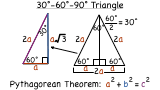
Looking at a 30-60-90 triangle? Trying to find a missing side length? You could use the Pythagorean theorem, or you could use your knowledge of this special type of triangle to get that missing measurement. In this tutorial, see how to solve for a missing side length by using your knowledge of 30-60-90 triangles to find a scale factor and set up an equation to solve!
-
How Do You Solve a Problem Using an Angle of Elevation?
This tutorial provides a great real world application of math. You'll see how to use the tangent ratio to find the height of a hill. Take a look!
-
What is a 45°-45°-90° Triangle?
A 45-45-90 triangle is a special right triangle with some very special characteristics. If you have a 45-45-90 triangle, you can find a missing side length without using the Pythagorean theorem! Check out this tutorial to learn about 45-45-90 triangles!
-
What is a 30-60-90 Degree Triangle?
A 30-60-90 triangle is a special right triangle with some very special characteristics. If you have a 30-60-90 degree triangle, you can find a missing side length without using the Pythagorean theorem! Check out this tutorial to learn about 30-60-90 triangles!